The Bottle, the Note and the Five O'Clock Start: On the Road with Carlton's Milkman
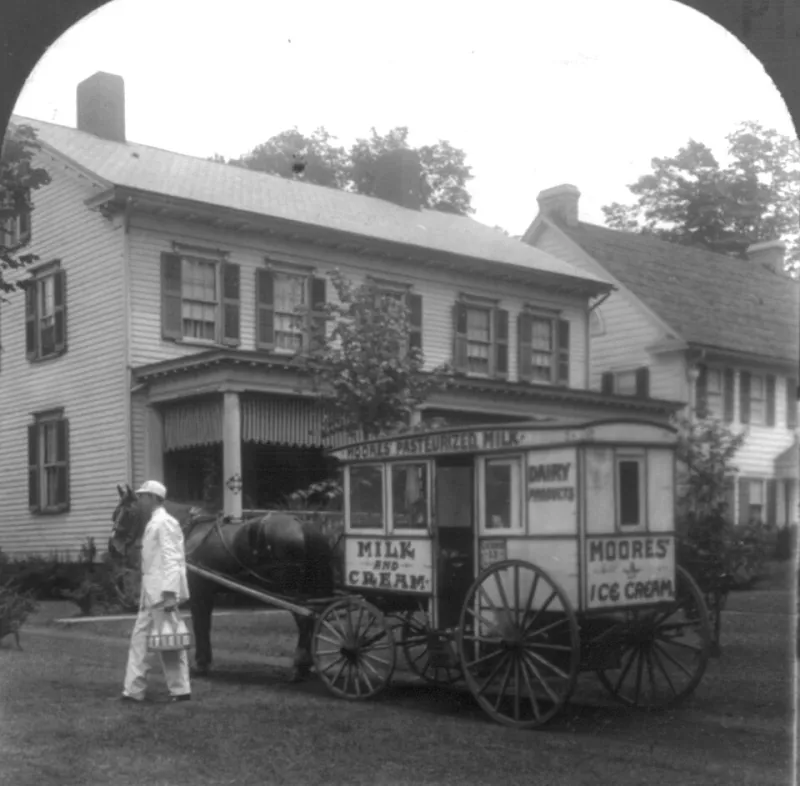
Photo: Keystone View Co, Public domain, via Wikimedia Commons
The yard behind the village hall is not usually somewhere you would choose to stand at ten past five on a cold morning. But that is where the float is, humming gently under a strip light, and that is where Carlton's milkman is checking a clipboard with the seriousness of a man defusing something.
His name is Martin. He has been doing this round for eleven years, and before him there was another Martin, and before that a fella called Des who apparently knew every dog in Carlton by name and every dog knew him. The float itself is newer than the idea it serves. It is white, boxy and surprisingly quiet, which matters when your working day begins while most of the village is still dreaming about a second duvet.
A float, a torch and an order book that never quite closes
The first thing you notice is the cold. Not dramatic, not snowy — not yet — just a proper November cold that finds the gap between your scarf and your collar. Martin hands me a spare torch and a pair of gloves that smell faintly of dairy and diesel. 'You'll want those,' he says. 'Bottles are colder than they look.'
We start on the estate near the recreation ground. The float creeps along at walking pace while Martin hops on and off, leaving pints on doorsteps with the soft clink that has soundtracked British mornings for generations. There is no drama to it. No urgency. Just a rhythm: stop, reach, place, check, move on.
'People think it's all snow and rosy cheeks,' he says. 'Mostly it's rain and remembering that Mrs Ellery wants semi-skimmed and her neighbour wants gold top and the house between them wants nothing because they've gone to their daughter's for a fortnight.'
By December, the order book thickens. Cream becomes a regular line rather than an occasional treat. Extra pints appear for visiting family. Someone always asks for a bottle of orange juice that Martin has to remember is for the grandson, not the dog. 'Christmas Eve is the big one,' he says. 'Not Christmas Day. Christmas Eve. Everyone wants everything at once, and they want it early.'
The notes in the bottles
The older customers leave their empties out the night before. Some leave notes tucked under the bottle, weighted with a stone or a bit of brick. Martin has a collection of these in the cab: a folded receipt with '2 skimmed please, back Sunday' written in biro; a birthday card that says 'thanks for the extra cream, love Jean'; a Post-it that simply reads 'NO MORE EGGS'. He has stopped trying to work out which house the egg note came from.
'You get to know the handwriting,' he says. 'You get to know the blue-tack on the door, the little chalk mark on the step, the envelope with the money in it.'
That is the other thing. Quite a few Carlton households still pay weekly, in cash, in an envelope left out with the empties. Martin prefers it. 'It's not about the cash,' he insists, though he admits it saves him a job. 'It's that you see people. You know if the envelopes stop. You know if someone's not picked up their milk for three days.'
He has, twice, knocked on a door after noticing bottles stacking up. Both times it turned out to be a hospital stay rather than anything worse. Both times the neighbours were already on it. But the milk round is often the first quiet alarm system a village has.
Frost, festive orders and the etiquette of the doorstep
There is an unwritten rule book to all this, and Martin knows it by heart. Leave the empties where they can be seen. Don't put them behind the bin. Don't block the path with the wheelie bin on collection day. If you've changed your order, leave a note before the night, not at six in the morning when the float is already at the end of the road.
And then there is the matter of the doorstep itself. Some people want their milk right by the door. Some want it on the step. Some, for reasons known only to themselves, want it on the little wall by the gate. Martin has a mental map of all of it, stored somewhere between the route and the names and the dog warnings.
Snow, when it comes, changes the round. The float is steady but not invincible. Hills get avoided. Long drives get walked. Martin keeps a shovel in the back and a bag of grit that is mostly for his own boots. 'You don't want to be the bloke who gets stuck at the bottom of Pinfold Lane on the busiest morning of the year,' he says.
But the snow also brings out the best of the village. People leave out flasks. Someone once left a pair of gloves on the wall with a note saying 'for the milkman, no arguments'. He still has them.
Why the five o'clock round still matters
By half six, the sky is doing that thin grey-blue thing and Carlton is starting to stir. A light comes on in a kitchen. A dog barks at nothing. Martin finishes the last stretch near the church, checks the clipboard one final time and climbs back into the cab with the satisfied sigh of a man who has done a day's work before most people have found their second sock.
He does not think of it as a tradition. To him it is a job, with invoices and diesel and an early alarm. But that is exactly why it matters. It is a small, reliable thread in village life — not nostalgic, not staged, just there. Cream for Christmas. Semi-skimmed on a Tuesday. A note in a bottle. A knock on a door when the bottles start piling up.
The float pulls away towards the next road, and the bottles stand in their rows along the doorsteps, catching the first light. Carlton wakes up slowly, and the milk is already there.