The Waiting List Diaries: Winter on Carlton's Allotments, Where Patience Is the First Crop
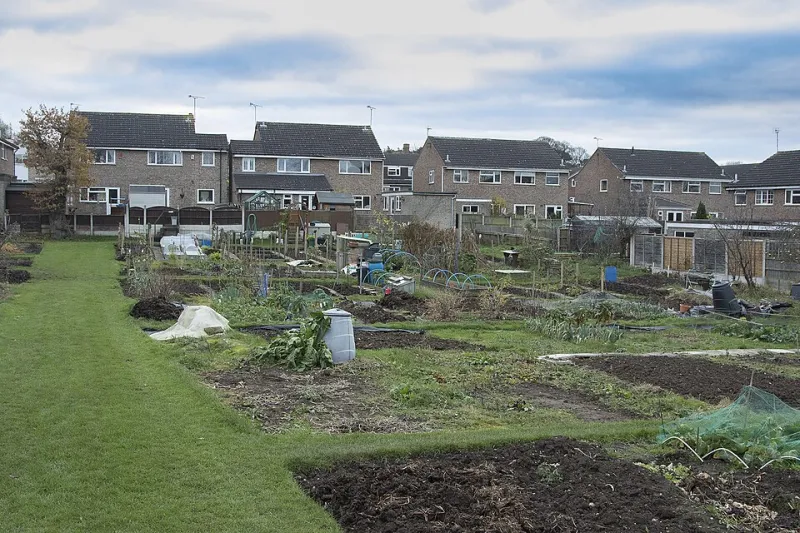
Photo: Malcolm Neal , CC BY-SA 2.0, via Wikimedia Commons
At ten to eight on a Saturday morning the site is mostly silhouettes: hawthorn hedge, shed roofs, a line of canes somebody has never got round to taking down. There is frost in the hollows of the path and a smell of cold soil that is somehow both sharp and comforting.
Margaret is on plot 14 and has been for thirty-one years. She arrives with a flask, a folding stool she does not use, and a plan she will abandon within ten minutes in favour of talking to whoever turns up. “Nobody comes down here to work,” she says, unscrewing the flask. “They come down here to work and then they get waylaid. That's the whole point.”
The parsnips are still in the ground because frost improves them, converting starch to sugar, and because lifting them as you need them means a Sunday roast in January comes with about four feet of walking attached. This is the sort of fact that gets passed across a hedge rather than looked up.
A gate, a padlock and a hundred small courtesies
The site holds ninety-six full plots across roughly four acres, split by grass paths wide enough for a wheelbarrow and a conversation, which is the correct width. There is one standpipe, one noticeboard, a communal shed for tools that nobody is entirely sure about, and a compost area that has been “about to be reorganised” since the last decade.
It is also, quietly, one of the most socially complicated pieces of land in the village. Nothing about it appears in any rulebook you can read from the road.
Five years is not a typo
The waiting list currently sits at a little over a hundred names. That translates to five years for a full plot, sometimes six, occasionally less if somebody takes on a half plot or inherits a share. Dev, who has been secretary for nine years and looks after the paperwork from a kitchen table, is careful about how he puts it.
“It's not that the committee is precious,” he says. “It's that a plot only comes free when somebody leaves, and leaving usually means moving house or worse. We have had three vacancies this year. Three. And eleven enquiries in one week in April.”
The surge since 2020 has not really subsided, and neither has the reason for it: people wanting to grow something, to be outside, to have somewhere to go on a Saturday that is not a shop.
What stood here before
The village has had allotments in one form or another since the early twentieth century, when the Allotments Acts obliged parish councils to think seriously about land for growing. The site was secured in the 1920s, and the parish minutes from that period — careful, spidery, and mostly about drainage — record the first tenants and the first complaints, which were also about drainage.
Through the war years the plots did their national service, and through the 1950s they kept pigs, hens and at least one goat that appears in three separate photographs and no written record. The decline came later, in the 1970s and 80s, when gardens got bigger, freezers arrived and half the site was nearly lost to something with tarmac in it. The hedge you walk past today was replanted in the mid-1990s by people who are, several of them, still on site.
That is the useful thing to remember when the list feels endless. These plots have been fought for before, and mostly by people with a flask.
The unwritten rules of a shared patch
Ask three plot holders for the rules and you will get four answers, but they converge.
- Return what you borrow, and return it clean. A rake comes back with the soil off it, or it does not come back at all.
- Do not comment on somebody's weeds unless you are holding a hoe. Advice is welcome when it arrives with a tool attached.
- The water butt is a shared resource with a private conscience. Fill your can, turn the tap off properly, and never drain it in a dry July because you have decided to wash a car.
- An open shed door is an invitation to say hello, not to step inside.
- Keep your hedge cut on the path side. The path is not yours, but the half-inch that overhangs it apparently is.
- Bonfires: not on a washday, not on a Saturday morning in summer, and never when the wind is going over the bungalows.
There are formal rules too — plot inspections, a tenancy agreement, the annual show in late summer with fiercely contested categories for onions and chutney. But most disputes are settled over a flask before they reach a committee, which is how it should be.
What to do with five years
If you are on the list, the temptation is to treat the wait as dead time. Plot holders will tell you it is not.
- Ask for a half plot. They turn over faster, and half a plot is more than most people can keep on top of in year one anyway.
- Grow something now. Containers, a windowsill, a borrowed corner of someone's garden. Parsnips do not need a plot; they need depth.
- Plant garlic in the autumn and broad beans in the cold. Both will forgive you a great deal.
- Do not dig frozen or waterlogged ground. Wait. This is the entire lesson, and it is a hard one.
- Come to the January seed swap at the village hall. Nobody checks your credentials. You will leave with more seeds than you can plant and at least one new acquaintance.
- Order your seeds in January, not March. The varieties you want will have gone by March. They always have.
What the land actually teaches
“People think it's about vegetables,” Margaret says, capping the flask. “It's about waiting. You wait for the frost, you wait for the ground, you wait for a plot. Then you get one and you find out you're waiting for a parsnip.”
She is right, and she is also describing something larger. A village allotment site is a shared resource with a long memory — fought over in the 1920s, dug over in the 1940s, half lost in the 1980s, fully booked today. Anyone joining it inherits all of that, plus a tap that freezes, a padlock that sticks, and a hundred neighbours who will absolutely tell you what you are doing wrong, then lend you the tool to do it right.
If you are on the list, keep the faith. If you are not, put your name down anyway. Five years is a long time, but it is nothing at all next to a decent parsnip.