Pinfolds, Pigs and a Vanished Orchard: Reading Carlton Through Its Street Signs
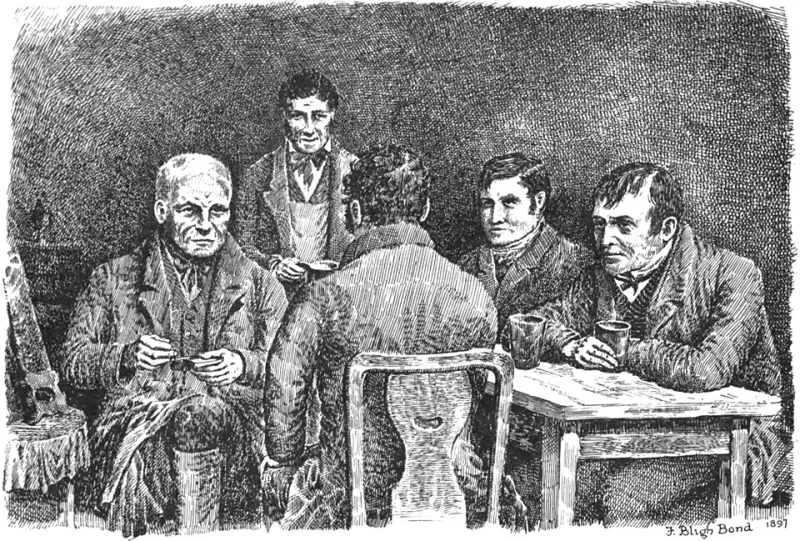
Photo: Frederick Bligh Bond, Public domain, via Wikimedia Commons
There is a particular kind of blindness that comes from living somewhere. You walk the same four streets for twenty years and stop seeing them entirely — the signs, the bends, the odd little gaps between houses that don't quite make sense.
Then one day you're standing at the top of Mill Lane waiting for a delivery, and you think: where is the mill?
It's a good question. Carlton's street names are a map of a village that has mostly gone, printed on a map of the village that replaced it. Look closely and you can still read the older one underneath.
A name that means 'the free peasants'
Start with the village itself. Carlton belongs to a large family of English place names — Carlton, Charlton, Carlton Curlieu — and most of them come down to the Old English ceorl, meaning a free peasant or a churl, plus tūn, an enclosure or settlement. Roughly: the farmstead of the ordinary folk.
It's an unglamorous name and a rather good one. Carlton was never a lord's vanity project. It was a place where people with no title and a bit of land got on with it, which anyone who has queued for the tip on a Sunday morning will recognise as an accurate description to this day.
Mill Lane: water, grain and a wheel that isn't there
The lane runs down towards the brook and then stops being a lane and starts being a path, which is the first clue. Mills need water, and the brook has been doing the same unhurried thing for a very long time.
In the parish's 1841 tithe apportionment — the great Victorian survey that matched every field to its owner and its tenant — the strip either side of the lane is recorded in small parcels, the classic signature of meadow and mill land rather than open arable. The mill itself survived into living memory in fragments: a stone sill, a channel, a deep, damp hollow in a garden that has never once grown a decent rose.
"My grandmother was adamant there was a wheel," says Margaret, who has lived at the Brook end since the 1960s. "She'd say, 'you can hear it when the water's high.' You can't. But you can hear the water, and honestly that's near enough."
Monk's Walk and the long shadow of the abbey
Monk's Walk is the name that gets people most excited, and slightly too excited. There was no monastery in Carlton. But for four centuries the parish sat within the estate of a religious house over the hill, and the name preserves the arrangement: land held by the abbey, worked by tenants, walked by men whose business took them across the fields.
After the dissolution, the estate was broken up and the name stuck to the track long after the last man in a habit had any reason to use it. That is how most of these names survive — not as monuments but as habits. A path is called what people have always called it, and then a developer puts up a sign and makes it official.
The pinfold: where stray beasts went
Pinfold Close is easy to miss, a small modern cul-de-sac tucked behind the bus shelter. The pinfold was anything but modern: a walled pound where the parish constable impounded stray animals until their owner paid a fine.
Pigs, mostly. Cattle, occasionally. A goose with a sense of adventure.
These pounds were a standard piece of village infrastructure, and their names outlived them almost everywhere, because the plot often remained open ground for decades after the enclosure and enclosure always looks like an opportunity. The wall would have been chest-high, rough stone, watched over by somebody whose entire job was a mild form of hostage negotiation.
Orchard Rise, Kiln Croft and the trades that fed the village
Orchard Rise is the newest-sounding name on the estate, and the oldest reality. The field here appears on the 1880s ordnance survey as an orchard — small, tight-planted, one of several that ringed the village to supply fruit for eating, cider and market.
The trees went in stages: some to the great gales of the early twentieth century, more to the post-war demand for housing, and the last few to a general sense that nobody was picking them anyway. When the estate went up in the 1970s, the field name was kept and promoted to a street. There is, as the more sardonic residents point out, one apple tree left, and it belongs to number 14.
Kiln Croft tells a similar story. A croft is a small enclosed piece of ground, and the kiln was almost certainly for lime or brick — the sort of smoky, necessary industry that made a village self-sufficient but never made it into the guidebooks.
New names, old habits
What's interesting is that Carlton's newest names keep doing exactly what the old ones did. Developers don't invent; they rummage. Bramble Court is named for the scrub that had to be cleared. Meadow View looks at a meadow that is now, admittedly, mostly a drainage basin. Those names will look just as archaeological in eighty years, when somebody stands on a corner and wonders where the brambles went.
Why a road name is never just a road name
There's a practical point underneath the nostalgia. Street names are one of the few records the village keeps without meaning to — a paper trail of what was grown, milled, grazed and argued over here before anyone thought to write a history of it.
They also give us a way to be interested in our neighbours. Ask the person at the end of Pinfold Close what the name means and you'll get a conversation, an opinion and possibly a photograph of a goose.
So next time you're waiting at the junction of Kiln Croft and Monk's Walk, glance at the sign. It's not decoration. It's a footnote to a much longer story, and it's been sitting there in the rain the whole time.